Wikimedia Commons · Public domain · Hover to magnify, click for fullscreen
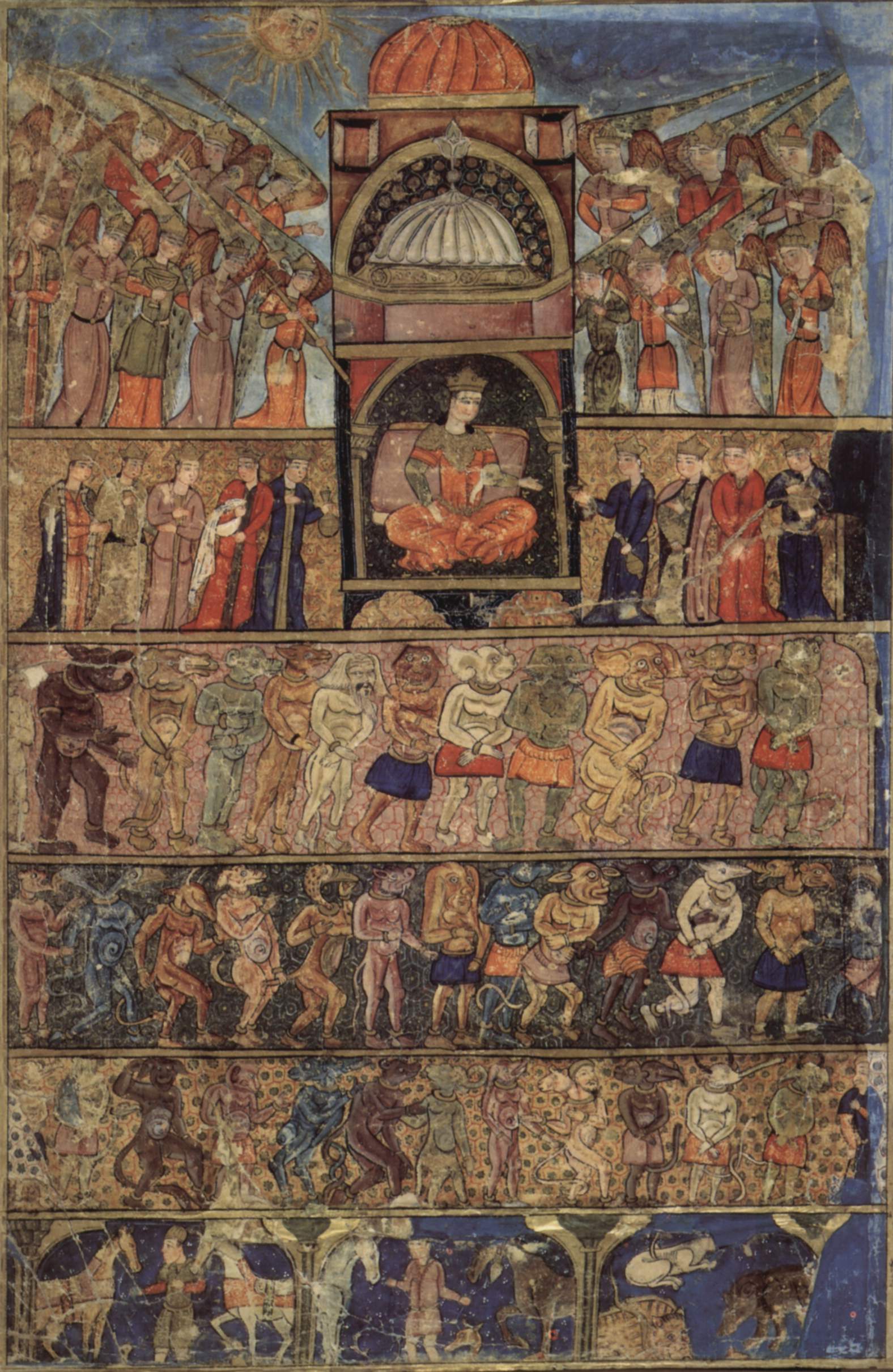
Original fileKing Solomon Enthroned with His Court and Host of Spirits
Sulaiman-Nama des Saraf ad Din-Musa Firdansi, Frontispiz, Szene: König Salomo und Bilkis, Königin von Saba. CBL T 406.2

About This Work
The composition is organized into horizontal registers. In the top register, King Solomon sits centrally in a domed pavilion, wearing a crown and orange robes, attended by courtiers and flanking groups of winged angels set against a gold sky with a radiating sun. Below, three middle registers display a multitude of diverse, grotesque spirit-beings: some possess animal heads (bull, lion, bird, dog), others have human-like but distorted faces, and some exhibit tails or clawed feet; they are painted in various skin tones from blue to red and brown. The bottom register shows a pastoral or terrestrial scene with horses and smaller animal figures. The color palette is rich, utilizing gold, deep blues, and earth tones to distinguish the celestial authority of Solomon from the chaotic nature of the spirit realm.
This illumination represents the Islamic tradition of Sulayman (Solomon) as a master of the jinn and supernatural forces, a narrative central to the 'Sulayman-nama' (Book of Solomon). It reflects the medieval Islamic cosmology that posits a hierarchy of creation where the Prophet-King holds dominion over the invisible, demonic, and animal worlds.