Loading...
Wikimedia Commons · Public domain · Hover to magnify, click for fullscreen
Original filemythologicalPublic domain
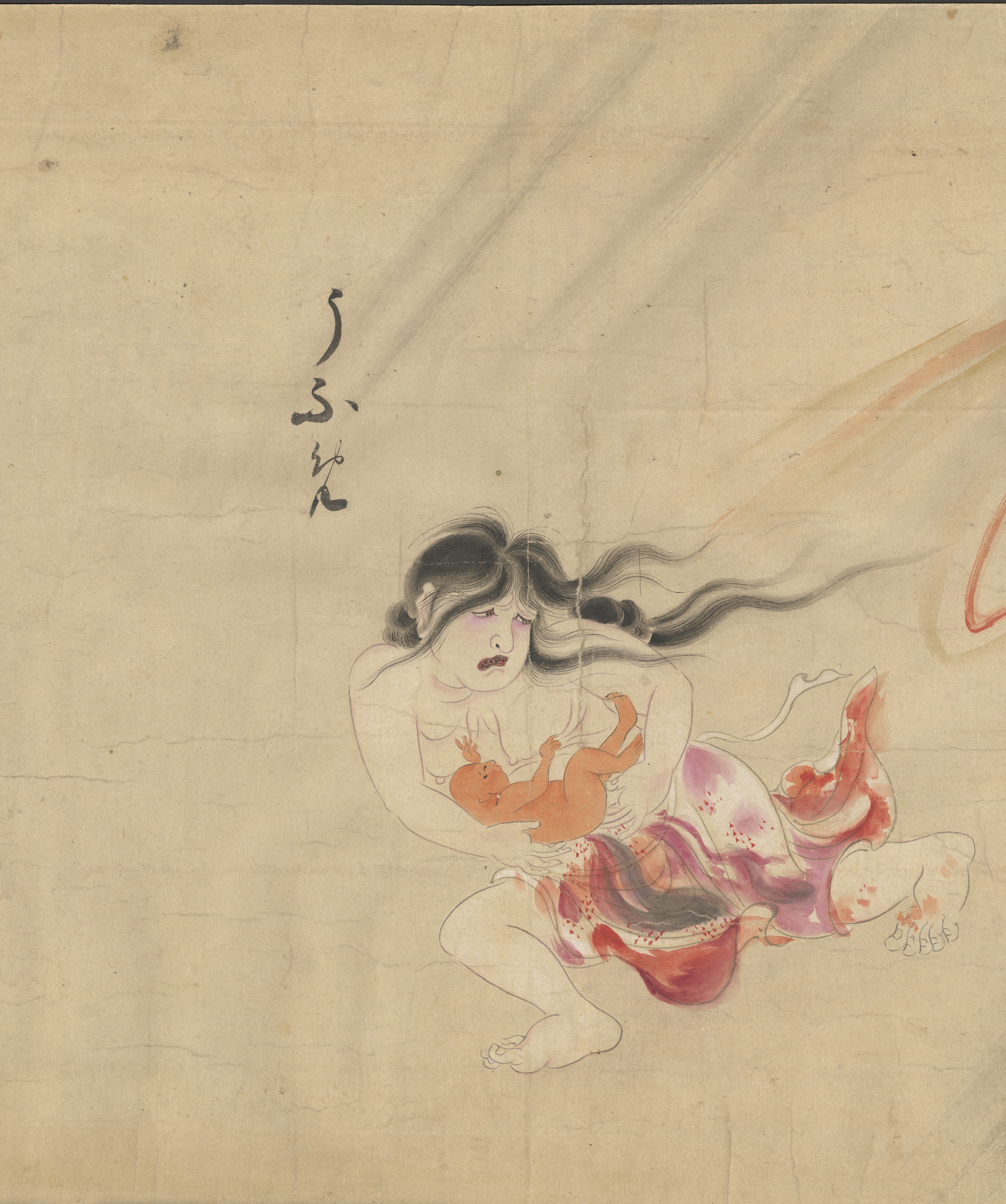
Ubume (Ghost Mother with Child)
12.Ubume
circa 1700date QS:P,+1700-00-00T00:00:00Z/9,P1480,Q5727902

About This Work
The image shows a female figure with long, dark, flowing hair and a distressed facial expression, characterized by heavy-lidded eyes and an open mouth. She is semi-nude, with her upper body exposed and wearing a tattered, blood-stained lower garment that cascades in washes of red and purple. She cradles a small, ochre-skinned infant against her chest. The background is a plain, weathered paper surface, suggesting a traditional scroll or hand-colored print.
The ubume is a prominent figure in Japanese folklore representing the lingering attachment of a mother who dies during labor, often said to appear to travelers to ask them to hold her infant. This imagery is deeply rooted in Buddhist-influenced traditions concerning the 'blood pool hell' (ketsubon-kyō) and the anxieties surrounding maternal mortality in pre-modern Japan.
Inscriptions(Japanese)
うふめ (Ubume)
Translation
Ubume
Connected Texts
Konjaku Hyakki Shūi
This text by Toriyama Sekien provides one of the primary historical compendiums for the visual codification of the ubume.
Collections
Provenance & Source
Object
TechniqueAI
woodcut
SupportAI
laid paper
PeriodAI
Edo period
CultureAI
Japanese
GenreAI
mythological
Digital Source
Source
Wikimedia Commons · Public domain
Original Resolution
3483 × 4167 px
Linked Data
AI AI-cataloged fields generated by gemini-3.1-flash-lite-preview on April 21, 2026. Getty identifiers are AI-inferred and may require verification.