/
Source Image
Loading...
English
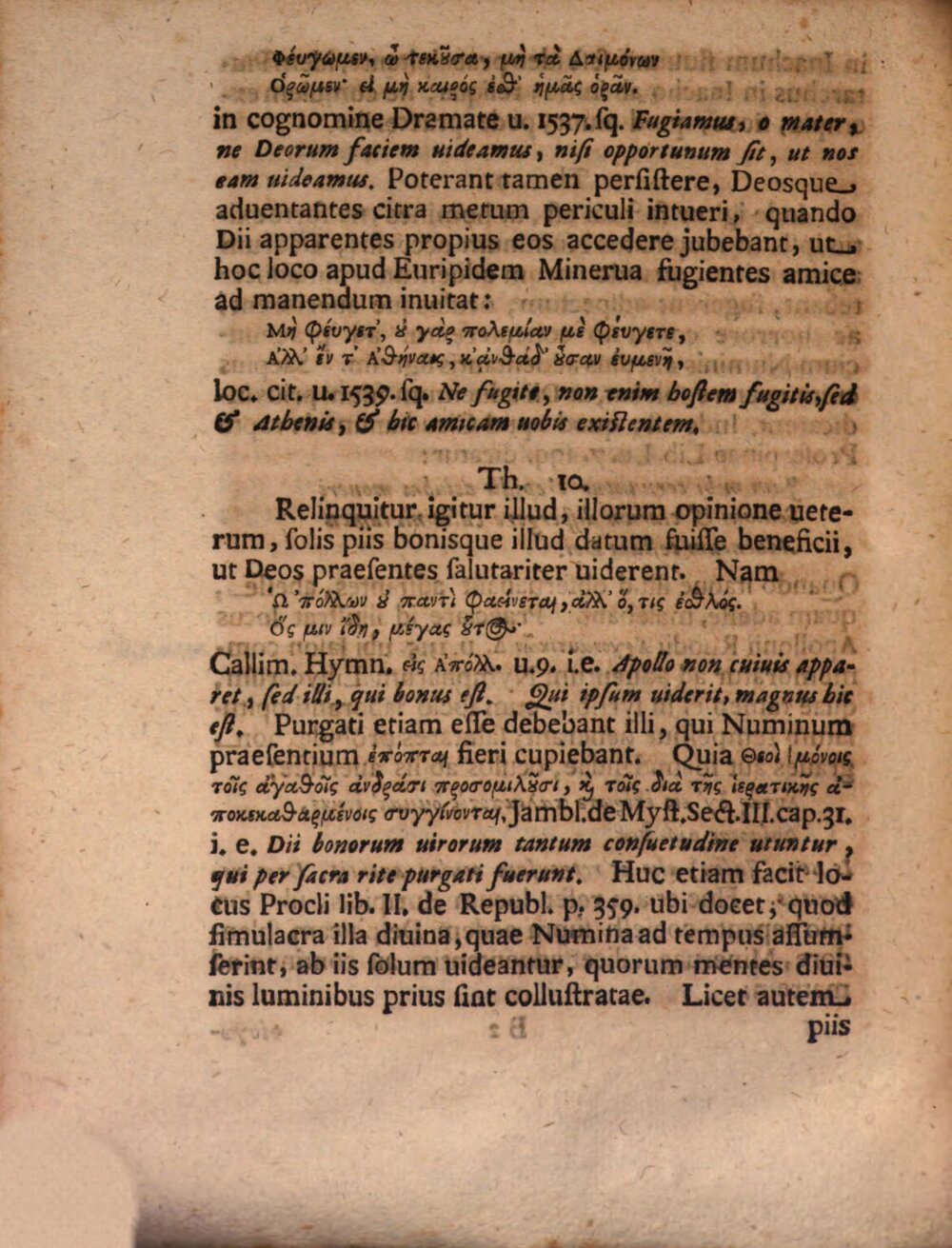
...let us flee, O mother, lest we see the faces of the Divine Spirits, unless it be the proper time for us to see them.
original Greek: "φεύγωμεν, ὦ τεκοῦσα, μὴ τὰ Δαιμόνων / ὁρῶμεν· εἰ μὴ καιρός ἐσθ' ἡμᾶς ὁρᾶν." From Euripides’ play Ion, lines 1537–1538. In the play of the same name, lines 1537 and following: “Let us flee, O mother, lest we see the face of the Gods, unless it be the opportune time for us to see it.” Yet they were able to stay and look upon the approaching Gods without fear of danger when the appearing Gods commanded them to draw nearer. In this passage from Euripides, Minerva The Roman name for the Greek goddess Athena. kindly invites those who are fleeing to remain:
Do not flee, for you do not flee an enemy,
but one who is friendly toward you both in Athens and here.
original Greek: "Μὴ Φεύγετ', οὐ γὰρ πολεμίαν μὲ Φεύγετε, / Ἀλλ' ἔν τ' Ἀθήναις, κ'ἀνθάδ' οὖσαν εὐμενῆ." Euripides, Ion, lines 1539–1540.
Thesis 10.
It remains, therefore, that in the opinion of the ancients, the privilege of seeing the Gods present in a beneficial way was granted only to the pious and the good. For:
Apollo does not appear to everyone, but only to him who is good.
He who has seen him, he is great.
original Greek: "Ὡ'πόλλων οὐ παντὶ φαίνεται, ἀλλ' ὅ, τις ἐσθλὸς. / Ὅς μιν ἴδῃ, μέγας οὗτος." Callimachus, Hymn to Apollo, line 9.
This means: “Apollo does not appear to just anyone, but to him who is good. Whoever has seen him, this man is great.” Those who desired to become beholders Greek: epoptai; a term used for those who reached the highest level of initiation in the ancient mysteries, literally "those who see." of the present Divinities also had to be purified. Because “the Gods only converse with good men, and they join themselves to those who have been rightly purified through the sacred rites.” original Greek: "θεοὶ μόνοις τοῖς ἀγαθοῖς ἀνδράσι προσομιλῶσι, καὶ τοῖς διὰ τῆς ἱερατικῆς ἀποκεκαθαρμένοις συγγίνονται." Iamblichus, On the Mysteries, Section III, chapter 31. To this also pertains a passage from Proclus, A 5th-century Neoplatonist philosopher. Book II of On the Republic, page 359, where he teaches that those divine forms which the Divinities assume for a time are seen only by those whose minds have first been illuminated by divine lights. However, although...
Use ← → arrow keys to navigateSwipe left/right to navigate·Produced by SourceLibrary.org in Amsterdam, 2026