/
Source Image
Loading...
English
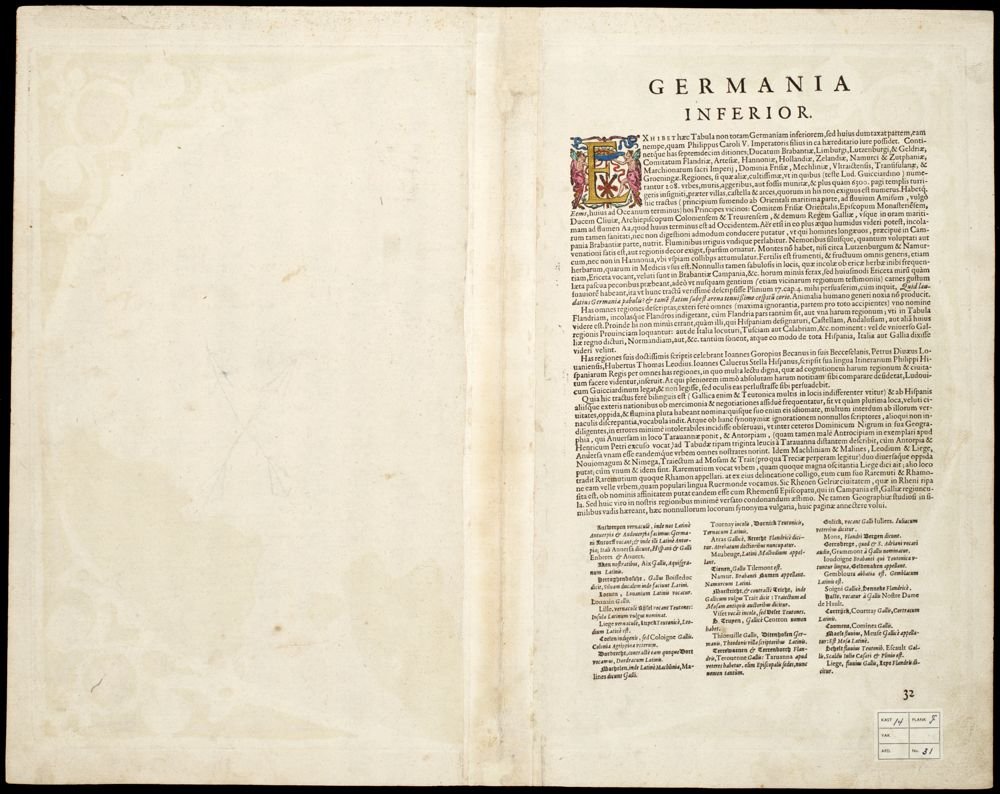
GERMANIA INFERIOR.
A decorative woodcut depicts a coat of arms featuring a shield divided into four quarters. It displays various lions rampant and passant, representing the Habsburg territories and associated provinces of the Low Countries.
This map does not show all of Lower Germany, but only that part which Philip, son of the Emperor Charles V, possesses by hereditary right. These seventeen provinces are contained herein: the Duchies of Brabant, Limburg, Luxembourg, and Guelders; the Counties of Flanders, Artois, Hainaut, Holland, Zealand, Namur, and Zutphen; the Marquisate of the Holy Empire; and the Lordships of Friesland, Mechelen, Utrecht, Overijssel, and Groningen.
These regions are most highly cultivated—if any others are—as there are counted within them (witnessed by Lodovico Guicciardini) 208 cities fortified by walls, ramparts, or moats, and more than 6,300 villages marked by temples and towers, in addition to villas, castles, and fortresses, of which there is a significant number.
Beginning from the eastern seaboard, this tract extends to the river Amisus, commonly called the Eems, which is its boundary toward the ocean. Its neighboring princes are: the Count of East Friesland, the Bishop of Münster, the Duke of Cleves, the Archbishop of Cologne, and the Archbishop of Trier; and finally, the King of France, extending to the seacoast at the river Aa, which is its boundary to the west.
Although the climate may seem more humid than is proper, it is thought to be quite conducive to the health and digestion of the inhabitants, as it nurtures people of long life, especially in the countryside of Brabant. It is irrigated on all sides by rivers. It is scattered with groves and woods sufficient for pleasure or hunting, or as required by the beauty of the region. It has no mountains, except around Luxembourg and Namur, and also in Hainaut, where it rises into hills. It is fertile in grain and fruits of every kind, including herbs used in medicine.
In some sandy places, which the inhabitants call Ericeta heaths due to the frequency of heather, it is less productive; however, these heaths provide remarkably lush pastures for livestock. So much so that, according to the testimony of neighboring regions, meat nowhere else has a sweeter taste. I am persuaded that Pliny described this tract very accurately in Book 17, Chapter 4, when he said: "What is more praiseworthy in Germany than the fodder? And it lies immediately beneath the sand, with a very thin layer of turf skin." It does not produce animals harmful to the human race.
Johannes Goropius Becanus in his Beceselana work on the language of the Cimbri, Petrus Divaeus of Leuven, Hubertus Thomas Leodius, and Joannes Calvete de Estrella the Spaniard have celebrated these regions in their most learned writings. The latter wrote in his own language an itinerary of Philip, King of Spain, through all these regions, in which he inserted many things worth reading that seem to contribute to the knowledge of these regions and cities. But whoever desires to obtain a fuller, or rather, absolute knowledge of them, should read Lodovico Guicciardini; he will persuade himself that he has not merely read them, but surveyed them with his own eyes.
Because this tract is almost bilingual—as French and Teutonic are used indiscriminately in many places—and is assiduously frequented by Spaniards and other foreign nations for the sake of trade and negotiation, it happens that many places, such as cities, towns, and rivers, have multiple names. Everyone gives them names in their own idiom, which often differ greatly from the local vernaculars.
Due to this ignorance of synonymy, I have observed that some writers, otherwise not diligent, have fallen into errors that are by no means tolerable. Among others, Domenico Nigro in his Geography places Antwerp at the location of Thérouanne, and describes Antwerp (which he nevertheless incorrectly calls "Antropia" in the copy printed by Henricus Petri) as being thirty leagues distant from Thérouanne on the bank of the Table—whereas all our countrymen know that Antwerp and Antuersa Antwerp are one and the same city. He likewise thinks Mechelen and Malines, Liège and Liege, Nijmegen and Nimega, and Maastricht and Trait (for which Treciæ is incorrectly read) are two different towns, when they are one and the same. He calls a city "Rarerautium," which he also says with great negligence is called Liege; in another place, he reports that "Raremutium" is also called Rhamon. From his description, I gather that with his "Raremutium" and "Rhamon" he means the city which we in the common tongue call Ruermonde. Likewise, he thinks Rheoen, a city of Guelders located on the bank of the Rhine, is the same as the Bishopric of Reims in Champagne, a small region of France, due to the similarity of the name. But I consider this forgivable for a man so little versed in our regions. Lest students of geography stumble on similar shoals, I have wished to annex these common synonyms of certain places to this page.
Antwerpen in the vernacular, from which we form the Latin Antuerpia and Antuorpia: the Germans call it Antorff, and from that comes the Latin Antorpia; likewise, the Spaniards and French say Anversa.
Enberrs and Anvers.
Aken to our people, Aia to the French, Aquifgranum in Latin.
S'Hertogenbosche, which they call Boldu or Boisleduc; from this, the Latins make Silua ducis (Duke's Forest).
Louen, which we call Louanium in Latin. Louania to the French.
Lille, which the Teutons call Riffel in the vernacular: it is commonly named Insulæ in Latin.
Liege in the vernacular, Luijck in Teutonic, Leodium in Latin.
Coelen to the natives, but Colonia to the French. Colonia Agrippina to the ancients.
Dordtrecht, which we call Dort for short, Dordracum in Latin.
Mechelen, hence Machlinia in Latin; the French say Malines.
Tournay to the inhabitants, Doornick in Teutonic, Tornacum in Latin.
Arras to the French, Atrecht in Flemish. It is called Atrebatum by the more learned.
Maubeuge, called Malbodium in Latin.
Tienen, to the French it is Tilemont.
Namur, which the Brabanters call Namen. Namurcum in Latin.
Maestriecht, and for short Tricht; from this, the common French folk say Trait. It is called Traiectum ad Mosam by ancient authors.
Viset says the inhabitant, but Weset say the Teutons.
S. Truyen has the name Centron in French.
Thionville to the French, Dittenhofen to the Germans, Theodonis villa to Latin writers.
Terouenne and Terrenborch to the Flemings, Tervenne to the French; it is held as Taruanna among the ancients, once an episcopal seat, now only a name.
Gulick; the French call it Iuliers. It is called Iuliacum by the ancients.
Mons; the Flemings call it Bergen.
Gersberge is heard to be called S. Adrianu [Saint Adrian], it is named Grammont by the French.
Ioudoigne, which the Brabanters who use the Teutonic language call Getenaken.
Gemblours is an abbey; it is Gemblacum in Latin.
Soigni in French, Zinnicq in Flemish.
Balle is called Nostre Dame de Haule by the French.
Coertrijck, Courtray to the French, Cortracum in Latin.
Comines, Commines to the French.
Maseik is called Mosaie by the French, after the river; it is the Island of the Meuse.
Betuue is called Escault by the French, after the river; it is the Scaldis [Scheldt] according to Caesar and Pliny.
Liege is called Xeye by the Flemings, after the river.
Use ← → arrow keys to navigateSwipe left/right to navigate·Produced by SourceLibrary.org in Amsterdam, 2026