/
Source Image
Loading...
English
VII.
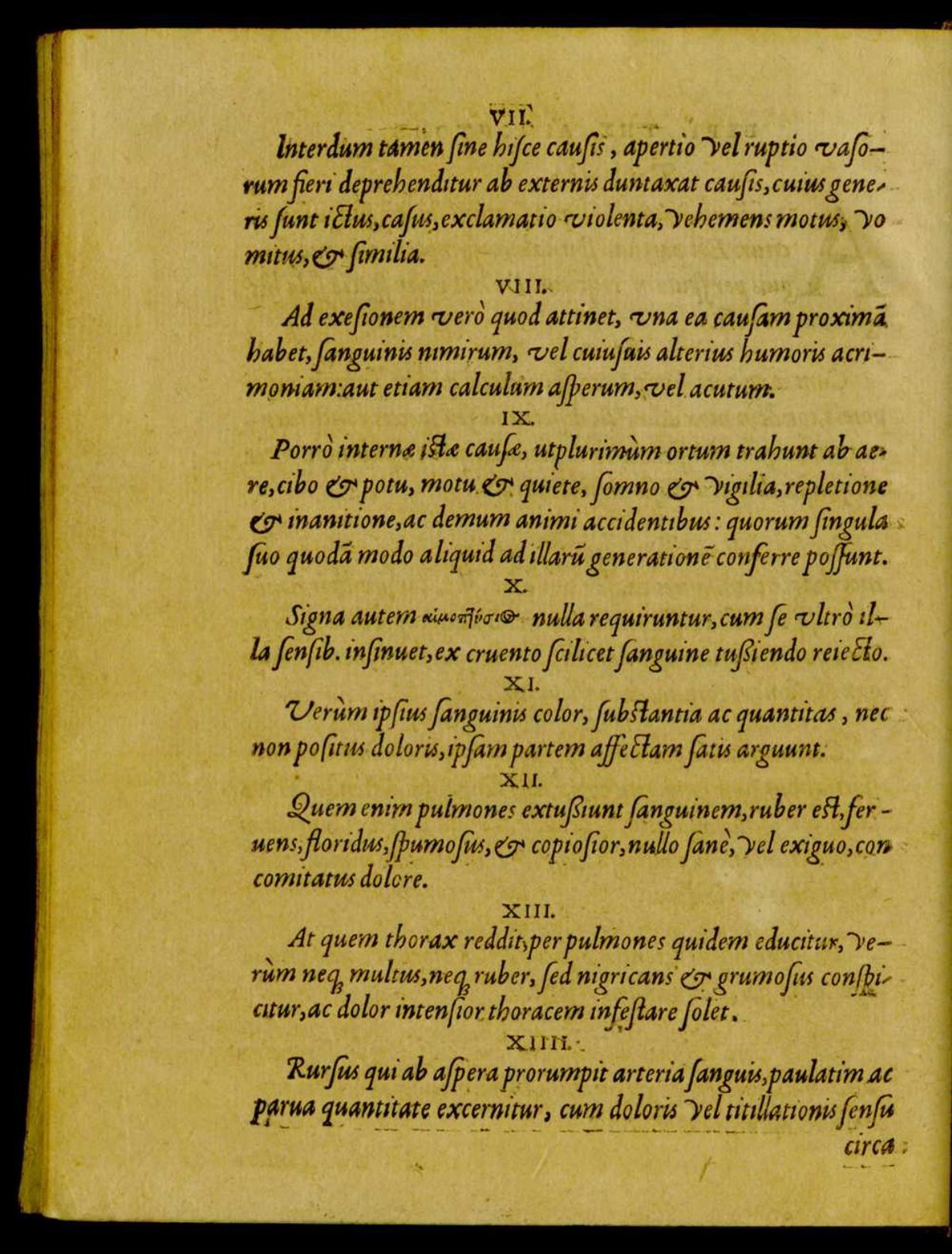
Sometimes, however, the opening or rupture of the vessels is found to occur without these causes, being produced solely by external factors, of which kind are blows, falls, violent shouting, vehement motion, vomiting, and the like.
VIII.
As for erosion, it has as its proximate cause the acrimony of the blood, or of any other humor; or even a rough or sharp calculus.
IX.
Furthermore, these internal causes for the most part derive their origin from air, food and drink, motion and rest, sleep and waking, repletion and inanition, and finally, the passions of the mind: each of which can in its own way contribute something to their generation.
X.
However, no signs of hemoptysis are required, since it presents itself of its own accord to the senses, namely, through the blood being ejected by coughing.
XI.
But the color, substance, and quantity of the blood itself, as well as the location of the pain, sufficiently indicate the part affected.
XII.
For the blood which the lungs cough up is red, hot, florid, and frothy, and more copious, accompanied by no pain, or certainly very little.
XIII.
But that which the thorax yields is indeed drawn out through the lungs, yet it is observed to be neither abundant nor red, but rather blackish and clotted, and a more intense pain is accustomed to afflict the chest.
XIIII.
Again, the blood that breaks forth from the trachea is excreted gradually and in small quantity, with a sense of pain or tickling.
Use ← → arrow keys to navigateSwipe left/right to navigate·Produced by SourceLibrary.org in Amsterdam, 2026