Loading...
Wikimedia Commons · Public domain · Hover to magnify, click for fullscreen
Original filereligiousPublic domain
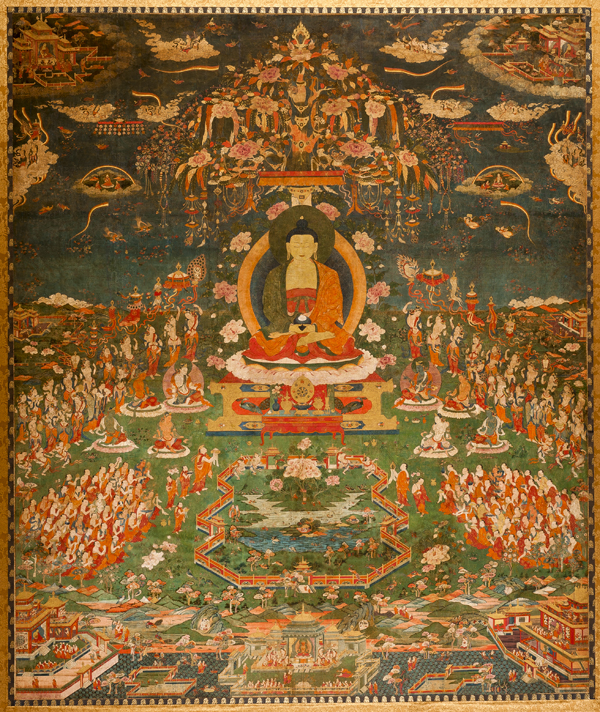
Amitabha in Sukhavati Paradise
'Amitabha in Sukhavati Paradise', Tibetan, circa 1700, San Antonio Museum of Art
circa 1700date QS:P,+1700-00-00T00:00:00Z/9,P1480,Q5727902

About This Work
Amitabha Buddha is depicted in a central position, gold-skinned with a serene expression, hands in the dhyana mudra holding an alms bowl, seated on a pedestal beneath a stylized tree with pink blossoms. To his left and right, two prominent bodhisattvas are seated on lotus thrones, while smaller figures of monks and celestial attendants are arranged in symmetrical tiers. Below, a geometric lotus pond with ducks and lilies occupies the foreground, leading to detailed architectural pavilions at the bottom edges. The palette is dominated by rich greens, deep blues, and accents of gold, creating a dense, hierarchical composition typical of Tibetan thangka painting.
This painting depicts the Pure Land of Amitabha, a central concept in Mahayana Buddhism, particularly in the Sukhāvatīvyūha Sūtras, which promise rebirth in this paradise through faith and devotion to Amitabha. It serves as a visual meditation aid for visualization practices intended to facilitate rebirth in this realm.
Connected Texts
Sukhāvatīvyūha Sūtra
The painting provides a direct visual representation of the descriptions of the Buddha Amitabha's Pure Land contained in this scripture.
Provenance & Source
Object
TechniqueAI
thangka
SupportAI
silk
PeriodAI
18th century
CultureAI
Tibetan
GenreAI
religious
Digital Source
Source
Wikimedia Commons · Public domain
Original Resolution
600 × 712 px
Linked Data
AATthangkaAIAAT StyleTibetanAI
AI AI-cataloged fields generated by gemini-3.1-flash-lite-preview on April 20, 2026. Getty identifiers are AI-inferred and may require verification.