Loading...
Wikimedia Commons · Public domain · Hover to magnify, click for fullscreen
Original filereligiousPublic domain
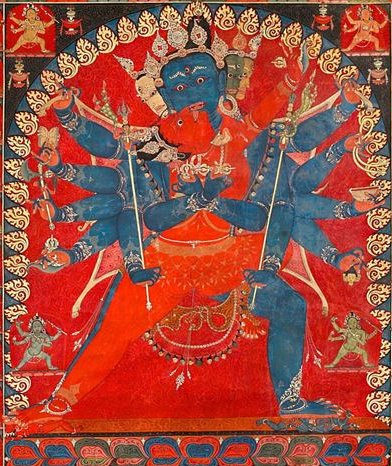
Cakrasamvara and Vajravarahi in Yab-Yum
'Paramasukha Cakrasamvara' from Central Tibet circa 1400, distemper on cloth (cropped)
circa 1400date QS:P,+1400-00-00T00:00:00Z/9,P1480,Q5727902

About This Work
Cakrasamvara has multiple heads and twelve arms, his blue body contrasting with the bright red body of the female deity Vajravarahi, who embraces him with her legs wrapped around his waist. They are set against a vibrant, fiery red circular mandorla bordered by stylized flames. Cakrasamvara holds a vajra (thunderbolt scepter) and a ghanta (bell) in his primary crossed hands, with other hands wielding various ritual implements including a damaru drum, a khatvanga staff, and a skull cup. Smaller, secondary figures of dancing dakinis occupy the four corners of the rectangular frame, which is edged with a decorative floral pattern.
This image represents the pinnacle of Buddhist Tantric practice in the Anuttarayoga class, specifically relating to the Cakrasamvara Tantra. The union of the deities symbolizes the non-dual integration of compassion (upaya) and wisdom (prajna) necessary for the realization of enlightenment.
Connected Texts
Cakrasamvara Tantra
The visual depiction of the primary deity and his consort as prescribed in the instructional verses of this Tantric text.
Collections
Provenance & Source
Object
TechniqueAI
distemper
SupportAI
cotton (textile)
PeriodAI
15th-century
CultureAI
Tibetan
GenreAI
religious
Digital Source
Source
Wikimedia Commons · Public domain
Original Resolution
392 × 466 px
Linked Data
AATdistemperAIAAT StyleTibetanAI
AI AI-cataloged fields generated by gemini-3.1-flash-lite-preview on April 20, 2026. Getty identifiers are AI-inferred and may require verification.