Loading...
Wikimedia Commons · Public domain · Hover to magnify, click for fullscreen
Original filereligiousPublic domain
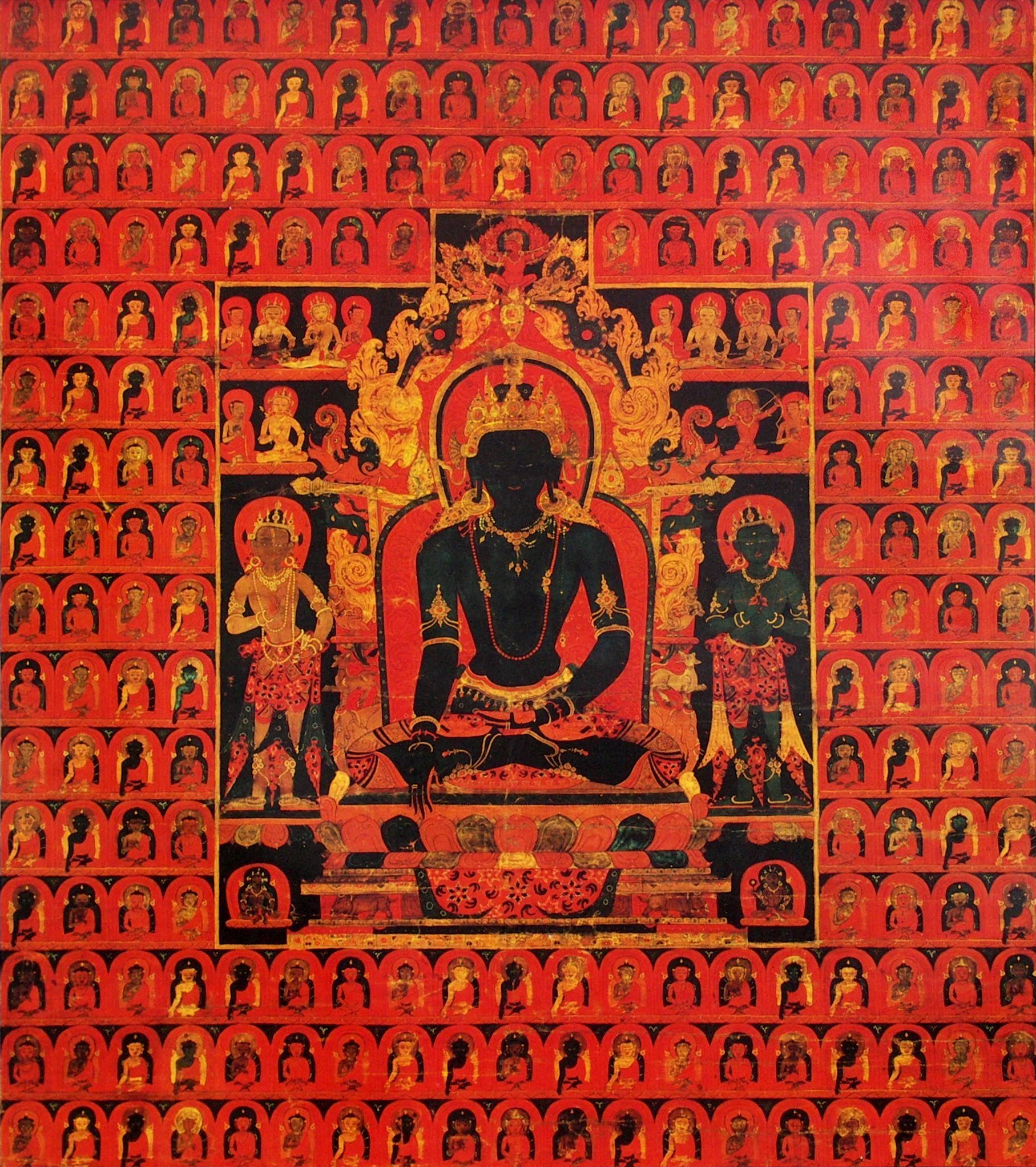
The Dhyani Buddha Akshobhya
'The Dhyani Buddha Akshobhya', Tibetan thangka, late 13th century, Honolulu Academy of Arts
late 13th century

About This Work
Akshobhya is depicted in deep blue, seated in the vajraparyanka posture on a lotus throne atop a rectangular dais. His right hand is in the bhumisparsha mudra (earth-touching gesture), while his left hand rests in his lap holding a vajra. He is crowned and adorned with jewelry, seated against a red backdrop within an elaborate golden architectural frame. The entire composition is densely populated with a grid of smaller, uniformly seated Buddha figures in individual arched niches, echoing the central divinity.
Akshobhya is one of the Five Wisdom Buddhas in Vajrayana Buddhism, representing the transmutation of anger into mirror-like wisdom. This iconographic arrangement of a central primary figure surrounded by a 'thousand' or manifold emanations is typical of Tibetan meditative scrolls intended to facilitate visual realization of mandalas.
Connected Texts
Vajradhatu Mandala
The iconographic arrangement reflects the hierarchal structure of the Vajradhatu (Diamond Realm) cycle of teachings.
Collections
Provenance & Source
Object
TechniqueAI
tempera
SupportAI
silk
PeriodAI
13th-century Tibetan
CultureAI
Tibetan
GenreAI
religious
Digital Source
Source
Wikimedia Commons · Public domain
Original Resolution
1815 × 2044 px
Linked Data
AATtemperaAIAAT StyleTibetanAI
AI AI-cataloged fields generated by gemini-3.1-flash-lite-preview on April 20, 2026. Getty identifiers are AI-inferred and may require verification.