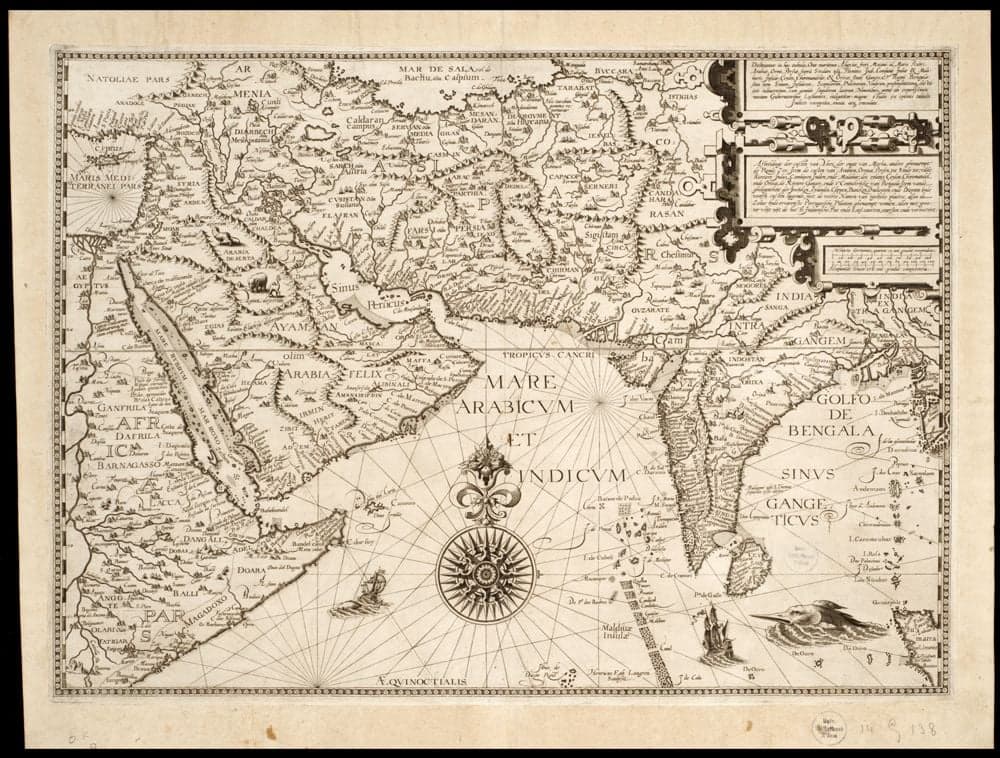
Deliniantur in hac tabula orae maritimae Abexiae, freti Mecani al Maris Rubri ... / magno s...
Deliniantur in hac tabula orae maritimae Abexiae, freti Mecani al Maris Rubri ... /, magno studio ex optimis tabulis Indicis recognita, omnia atque emendata = Afbeeldinge der custen van Abex, der engte van Mecha, anders ghenaempt de Roode Zee, item de custen van Arabien, Ormus, Persen, tot Sinde toe, vanden rieviere Indus, Cambayen, Indien, ende Malabar, des eylants Ceylon, Choromandel, ende Orixa, de rijviere Ganges, ende t'Coninckrijcke van Bengala, item vande ghelegentheijt der inwijcken, eylanden, clippen, bancken, ondiepten ende diepten byde voorschreven custen liggende, met de rechte namen van igelijcke plaetse, alsoo de zelve byde ervarenste Portugeesche pilooten ghenaempt worden / alles met grooter vlijt uijt de beste Indiaensche pas ende lees-caerten, oversien ende verbeetert / Henricus F. ab Langren sculpsit.
Latin
1596
1 pages
First Translation
No prior complete English translation of this text has been found.
The work in question is a specific nautical map engraved by Henricus F. a Langren for Jan Huygen van Linschoten's 'Itinerario' (1596). Maps of this nature, which contain Latin legends and cartographic labels, are not 'translated' in the literary sense. While the 'Itinerario' itself was translated into English in 1598, the map's Latin text (the specific object of this inquiry) remains a cartographic element rather than a translatable text, and no English translation of this specific Latin map legend exists as a separate work.
Verified Apr 1, 2026 via local catalogs, google books · methodology
About This Book
geographyhistory
This map captures the maritime world from Abyssinia to the Ganges as seen by 17th-century explorers. It translates hard-won Portuguese intelligence into a precise, navigable visual record.
Pages
OverviewPages
Showing 1 of 1
1