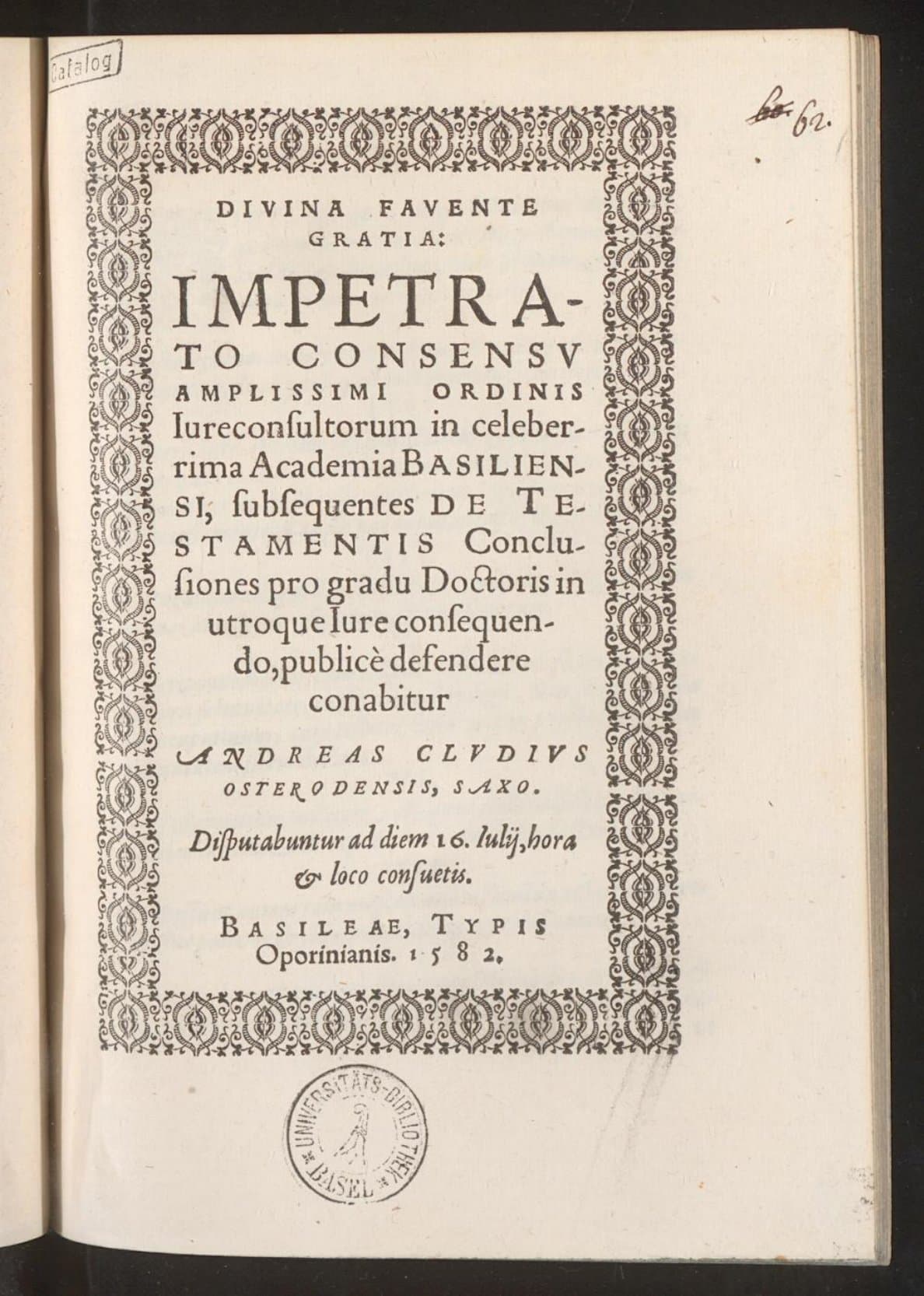
Divina favente gratia: Impetrato consensu amplissimi ordinis Iureconsultorum in celeberrima Academia Basiliensium, subsequentes de testamentis Conclusiones pro gradu Doctoris in utroque Iure consequendo, publice defendere conabitur Andreas Cludius Osterodensis, Saxo
Divina favente gratia: Impetrato consensu amplissimi ordinis Iureconsultorum in celeberrima Academia Basiliensium, subsequentes de testamentis Conclusiones pro gradu Doctoris in utroque Iure consequendo, publice defendere conabitur Andreas Cludius Osterodensis, Saxo : Disputabuntur ad diem 16. Iulij, hora & loco consuetis
Latin
1582
8 pages
First Translation
No prior complete English translation of this text has been found.
The work is a 1582 academic dissertation by Andreas Cludius titled 'Divina favente gratia... de testamentis Conclusiones'. Extensive searches across scholarly catalogs (UNESCO Index Translationum, Brill, Open Library, Internet Archive) yielded no evidence of any English translation, complete or partial. Given the nature of the work as a specific 16th-century legal dissertation, it is highly unlikely to have been translated into English.
Verified Mar 30, 2026 via local catalogs, google books, open library, internet archive, ustc · methodology
About This Book
law
Andreas Cludius explores why the law guards the final wishes of the dying with such intensity. This dissertation dissects the boundary between rigid civil formalities and the radical freedom granted to soldiers in the heat of war.
Pages
OverviewPages
Showing 7 of 8
1

3

4

5

6

7

8