


Illustrations
Browse all60 images extracted from 18 books
This monumental engraving serves as a visual encyclopedia of musical theory and its mathematical foundations. The structure is a 'Temple of Music,' where architectural elements like columns and arches house organ pipes and complex tables that illustrate the ratios of musical intervals. At the base, figures are shown in a workshop, perhaps referencing the legendary discovery of musical proportions by Pythagoras in a blacksmith's forge, while the upper levels connect earthly music to the celestial harmony of the spheres.
This iconic engraving depicts the 'Monochordum Mundanum' or World Monochord, a central concept in Robert Fludd's philosophy. A divine hand emerges from a cloud to tune the single string of the universe, illustrating the belief that the cosmos is governed by the same mathematical and musical proportions found in music. The diagram maps the elements, planets, and celestial spheres onto musical intervals, representing the Pythagorean 'harmony of the spheres'.
This iconic engraving from Robert Fludd's 'Utriusque Cosmi Historia' presents a visual summary of the universe as a 'Mirror of Nature.' At the top, the hand of God holds a chain linked to the female personification of Nature, who in turn guides a monkey representing human Art or ingenuity. The surrounding concentric circles detail the hierarchy of existence, from the terrestrial elements and biological kingdoms to the celestial spheres of the planets and fixed stars.
This intricate engraving serves as the central visual argument for Robert Fludd's 'Philosophia Moysaica' (1638). It presents a complex cosmological diagram illustrating the relationship between the divine, the celestial, and the terrestrial realms through a series of interlocking circles and symbolic figures. Fludd, a prominent Hermetic philosopher and physician, used such imagery to synthesize biblical narrative with contemporary scientific and mystical thought, representing the unfolding of creation from the divine unity.
This vibrant frontispiece from Andreas Cellarius's 1660 celestial atlas, 'Harmonia Macrocosmica,' presents a grand allegory of astronomical science. In the foreground, scholars and astronomers study celestial globes and instruments, while above, putti unfurl a banner amidst the sun, moon, and zodiac signs. The image perfectly captures the Baroque era's fascination with mapping the heavens through both empirical observation and symbolic harmony.
This finely detailed engraving depicts Michael Maier, the author of Atalanta fugiens, at the age of 49 in 1617. Maier was a celebrated physician, alchemist, and counselor to Holy Roman Emperor Rudolf II; he is shown here with symbols of his learning and status, including a book and his family crest.

This elaborate hand-colored engraving illustrates the Aratean planetary system, a geocentric model of the universe where Earth sits at the center. Surrounding the central diagram are the twelve signs of the zodiac and scenes of astronomers with globes and instruments, showcasing the 17th-century's artistic approach to scientific documentation.

This seminal engraving depicts the 'Monochordum Mundanum' or World Monochord, a central concept in Robert Fludd's philosophy of universal harmony. A divine hand reaches from a cloud to tune the single string of the universe, which spans from the earthly elements of Earth, Water, Air, and Fire at the base to the highest celestial realms. The diagram meticulously maps musical intervals—such as the diapason and diapente—onto the structure of the cosmos, visually representing the Renaissance belief that the universe is governed by divine mathematical and musical proportions.

This iconic Rosicrucian emblem from Robert Fludd's 'Summum Bonum' (1629) features a central rose surrounded by the motto 'DAT ROSA MEL APIBUS' (The rose gives honey to the bees). The imagery contrasts the industrious bee gathering nectar from the rose with a spider's web on the left, symbolizing the different ways knowledge and spiritual truth can be approached or misused. It serves as a profound visual summary of Rosicrucian spiritual alchemy and the pursuit of divine wisdom.
All Books
Browse Full Catalog→70 books in this collection

Sacred and Truly Christian Philosophy, or Cosmic Meteorology
Robert Fludd
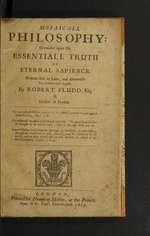
Mosaicall Philosophy
Robert Fludd
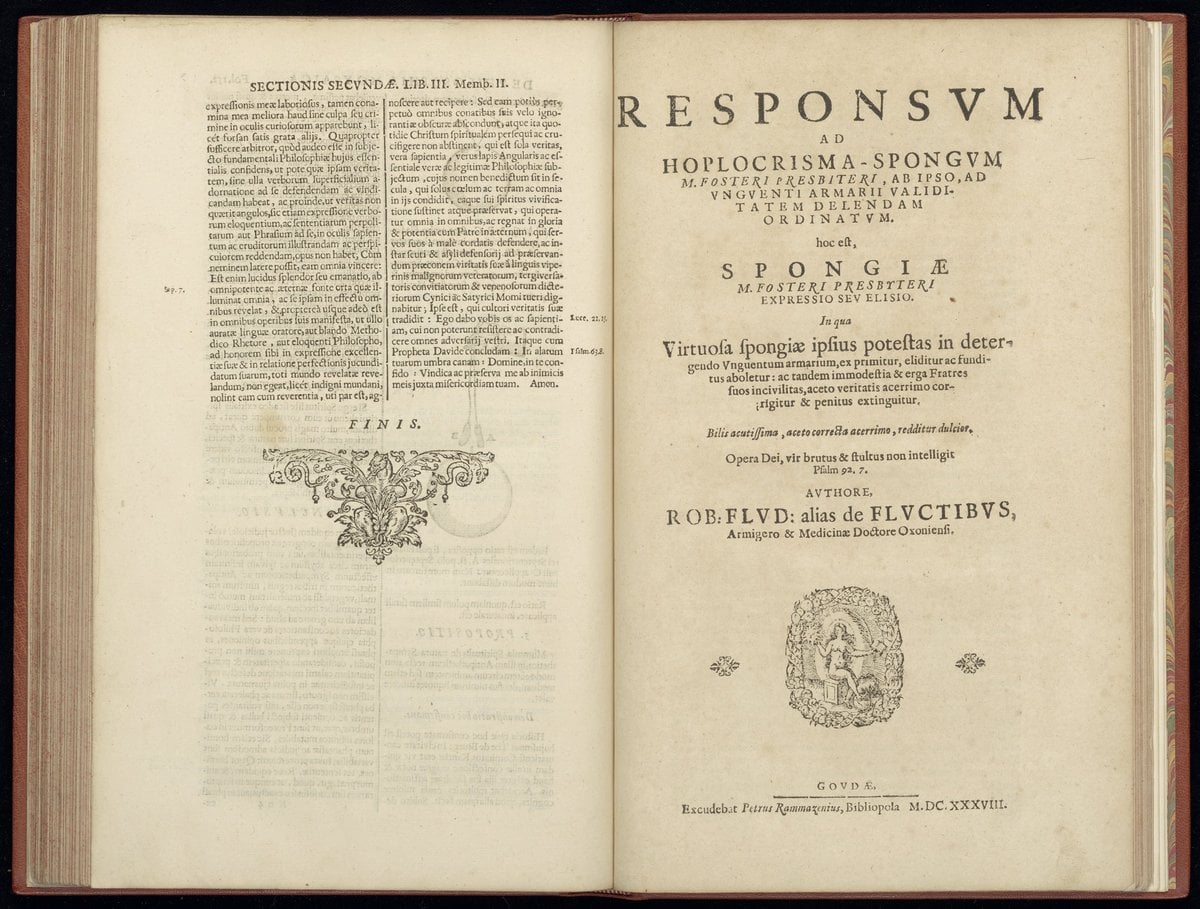
Response to Foster's Weapon-Salve Sponge
Fludd, Robert
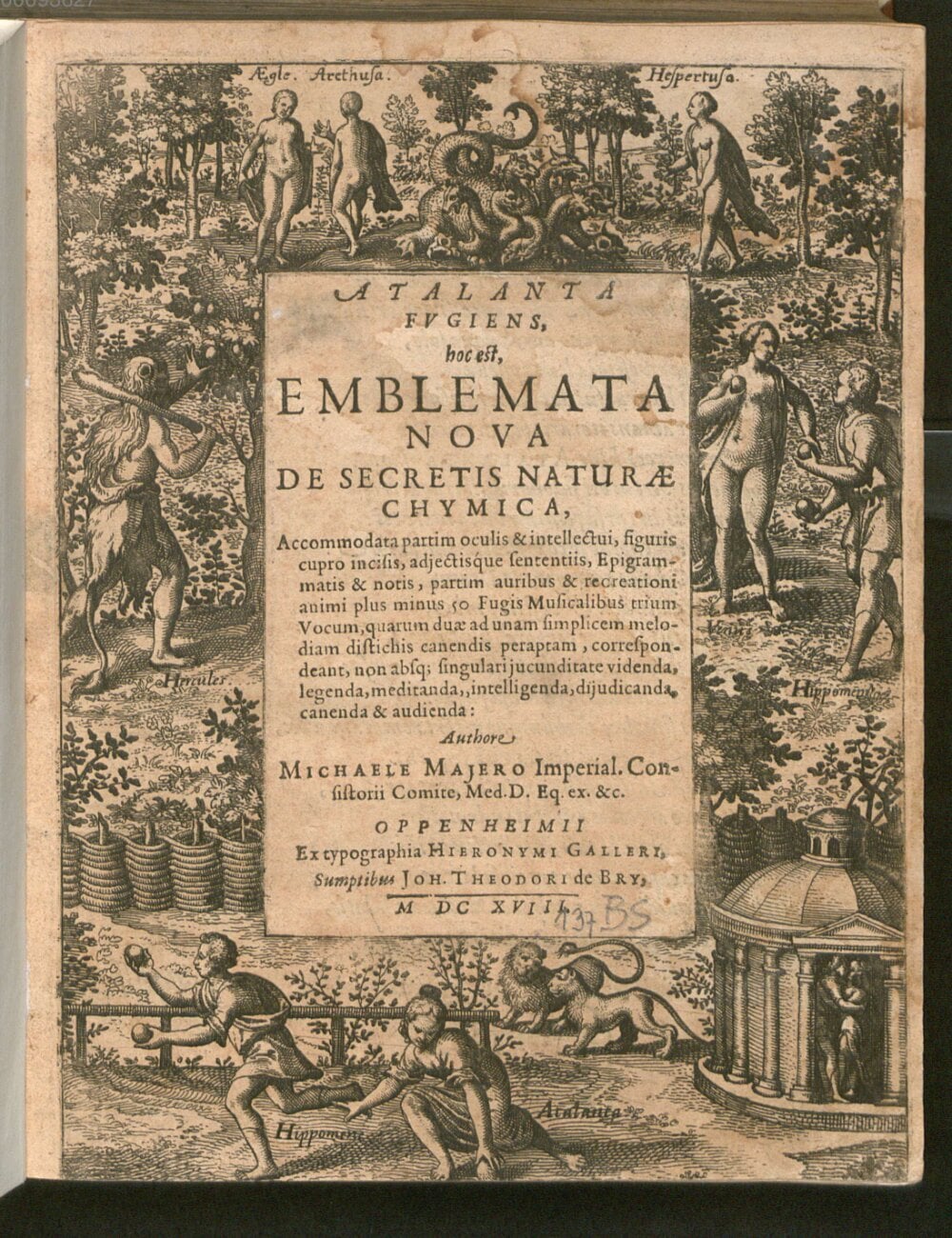
Michael Maier — Atalanta Fugiens (1618, Merian engravings)
Michael Maier
Supplement to the Catalogue of Books Prohibited by the Aulic Commission
Fludd Medicina